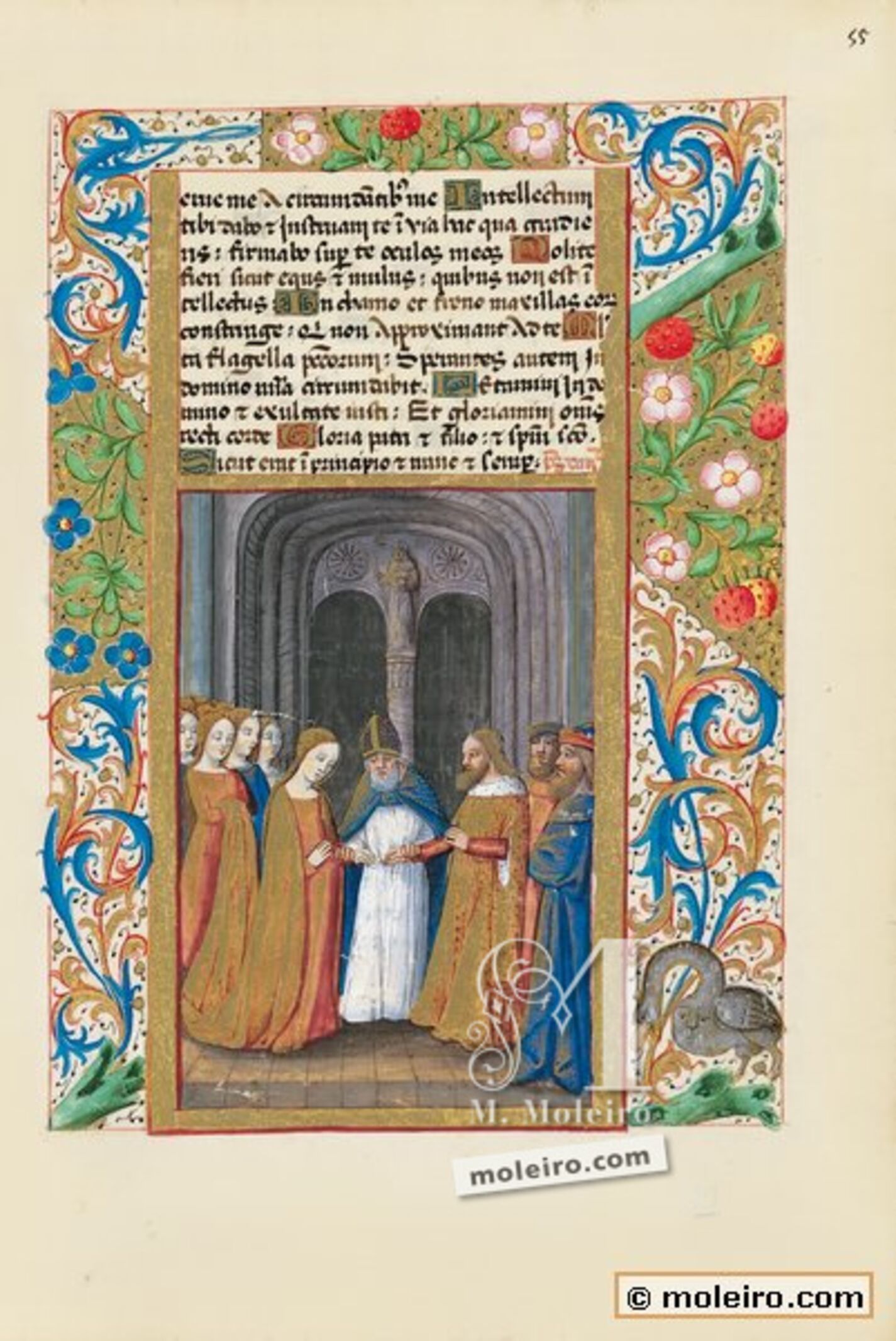
The illustration shows Michol on the left with the unbraided hair of single women together with a group of maidens, one of whom holds the golden cloak of Saul’s daughter. David is on the right in regal garb, but no crown, consisting of a gown with ermine-lined flaps or batwing sleeves and ermine around the neckline, over a garment and a purple jerkin with tight-fitting sleeves. Two men stand behind him. The officiating priest in episcopal garb in the centre joins the spouses’ hands. The scene is set in front of the entrance of a temple with an opening consisting of a basket-handle arch with archivolts featuring cord motifs and two doors. The mullion between them consists of a torso fust column and a Corinthian capital supporting a statue of a man holding a large candle in his right hand. This subject is not represented very often; however, despite belonging to a completely different context, it is very similar to the marriage scene appearing in Romuleon (Paris, Bibliothèque nationale de France, ms. fr. 364, f. 229r)
The marriage scene is typical of those usual in France at that time. The spouses are shown standing or kneeling with their hands joined in front of the priest blessing them. This symbolic gesture of being united in marriage was known in Roman law as Dextrarum junctio or Conjunctio manuum. Towards the year 1100 the first liturgical marriage rites appeared in northern France – those of the Anglo-Norman type to be precise. This is an indication of the increasing penetration of the clergy into family life: they confirm the consent of both spouses and enquire about any forbidden blood relationships that could prevent a legitimate marriage. Twelfth-century canonists and theologians, particularly in Paris, stated the Church’s concept of marriage precisely, adding the concept of consent and the sacraments to the more realistic and more earthly moral of their Carolingian predecessors who were concerned above all by the mutual faithfulness (fides) of the spouses as a social value and the decisive role of consummation in creating the bond. The importance given to the more spiritual elements from the 12th century onwards constituted progress in high-level, clerical culture. The traits in the new rites inherited from the civil context must be distinguished from the innovations stemming from spiritual aims. After confirming the consent and lack of consanguinity, the priest proceeds with a ceremony in which he is the main witness, ending with a prayer. The father or the next of kin responsible for the bride is the person who places her (sponsa) in the groom’s hands: the joining of their right hands symbolises a gift, which the Church was to interpret later as the spouses’ commitment to mutual faithfulness. In the 13th century, priests were to play the role of uniting them, thereby revealing their new power.