Continuing to illustrate episodes from the life of Alexander the Great, the painting on the opposite side of his search for the Fountain of Life shows one of Alexander’s grandest legendary accomplishments, that is, the erection of a huge iron wall that would keep the wild populations of Gog and Magog out of the civilized world.
The story features in the Koran in connection with the figure of Alexander (sura 18, verses 94-97, where the peoples are referred to as Yuj and Majuj) but it represents one of the most ancient myths of the dispersion of populations and languages to the farthest corners of the world. In Genesis, Magog was one of Japheth’s sons (Gen. 10: 2-5). In St. John’s Apocalypse, the peoples of Gog and Magog will be seduced by Satan and wage war against humanity (Rev. 20: 7-8).
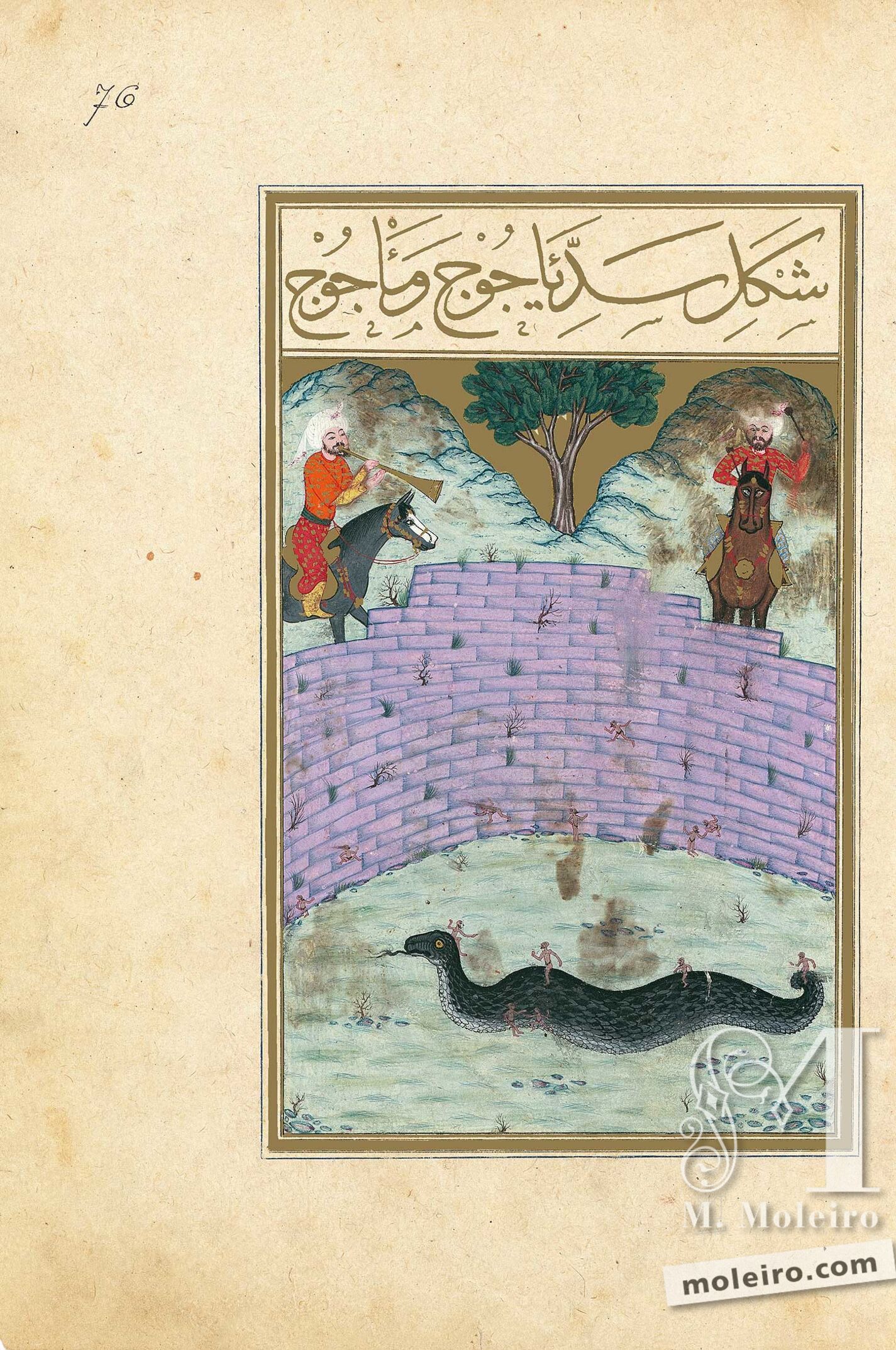
The lively illustration follows the story in the Koran and is an almost exact copy of the corresponding painting in the Kitab al-bulhan (f. 38r). Curiously, the viewpoint of the artist is as if he were looking at the scene from inside the lands of Gog and Magog. The wall, made of iron blocks covered with molten bronze making it so smooth it was impossible to climb, is depicted as a mauve brick barrier with a stepped upper section. Its enormity is emphasized by the diminutive size of the inhabitants of the lands of Gog and Magog in the foreground, four of whom are riding a large snake while seven others are frantically trying to climb the wall or wear away its surface by licking it with their scratchy tongues. Their wild behavior explains why they have to be kept locked away.
On the opposite side of the wall, the civilized world is represented in the upper part of the painting as a rocky, hilly landscape with a large central tree and a gold sky. On each side of the wall two horsemen are playing musical instruments, a long trumpet on the left and a drum on the right. Their large size underlines once again the difference between the civilized and the wild worlds. According to the story, the reason why loud music was played outside Alexander’s wall was that, once his army had left, the wild people of Gog and Magog were led to believe that a large number of people were still outside, guarding the barrier.
Stefano Carboni
The Metropolitan Museum of Art
Curatorial Assistant in Islamic Art
(Fragment of the Book of Felicity commentary volume)
Continuing to illustrate episodes from the life of Alexander the Great, the painting on the opposite side of his search for the Fountain of Life shows one of Alexander’s grandest legendary accomplishments, that is, the erection of a huge iron wall that would keep the wild populations of Gog and Magog out of the civilized world.
The story features in the Koran in connection with the figure of Alexander (sura 18, verses 94-97, where the peoples are referred to as Yuj and Majuj) but it represents one of the most ancient myths of the dispersion of populations and languages to the farthest corners of the world. In Genesis, Magog was one of Japheth’s sons (Gen. 10: 2-5). In St. John’s Apocalypse, the peoples of Gog and Magog will be seduced by Satan and wage war against humanity (Rev. 20: 7-8).
The lively illustration follows the story in the Koran and is an almost exact copy of the corresponding painting in the Kitab al-bulhan (f. 38r). Curiously, the viewpoint of the artist is as if he were looking at the scene from inside the lands of Gog and Magog. The wall, made of iron blocks covered with molten bronze making it so smooth it was impossible to climb, is depicted as a mauve brick barrier with a stepped upper section. Its enormity is emphasized by the diminutive size of the inhabitants of the lands of Gog and Magog in the foreground, four of whom are riding a large snake while seven others are frantically trying to climb the wall or wear away its surface by licking it with their scratchy tongues. Their wild behavior explains why they have to be kept locked away.
On the opposite side of the wall, the civilized world is represented in the upper part of the painting as a rocky, hilly landscape with a large central tree and a gold sky. On each side of the wall two horsemen are playing musical instruments, a long trumpet on the left and a drum on the right. Their large size underlines once again the difference between the civilized and the wild worlds. According to the story, the reason why loud music was played outside Alexander’s wall was that, once his army had left, the wild people of Gog and Magog were led to believe that a large number of people were still outside, guarding the barrier.
Stefano Carboni
The Metropolitan Museum of Art
Curatorial Assistant in Islamic Art
(Fragment of the Book of Felicity commentary volume)
