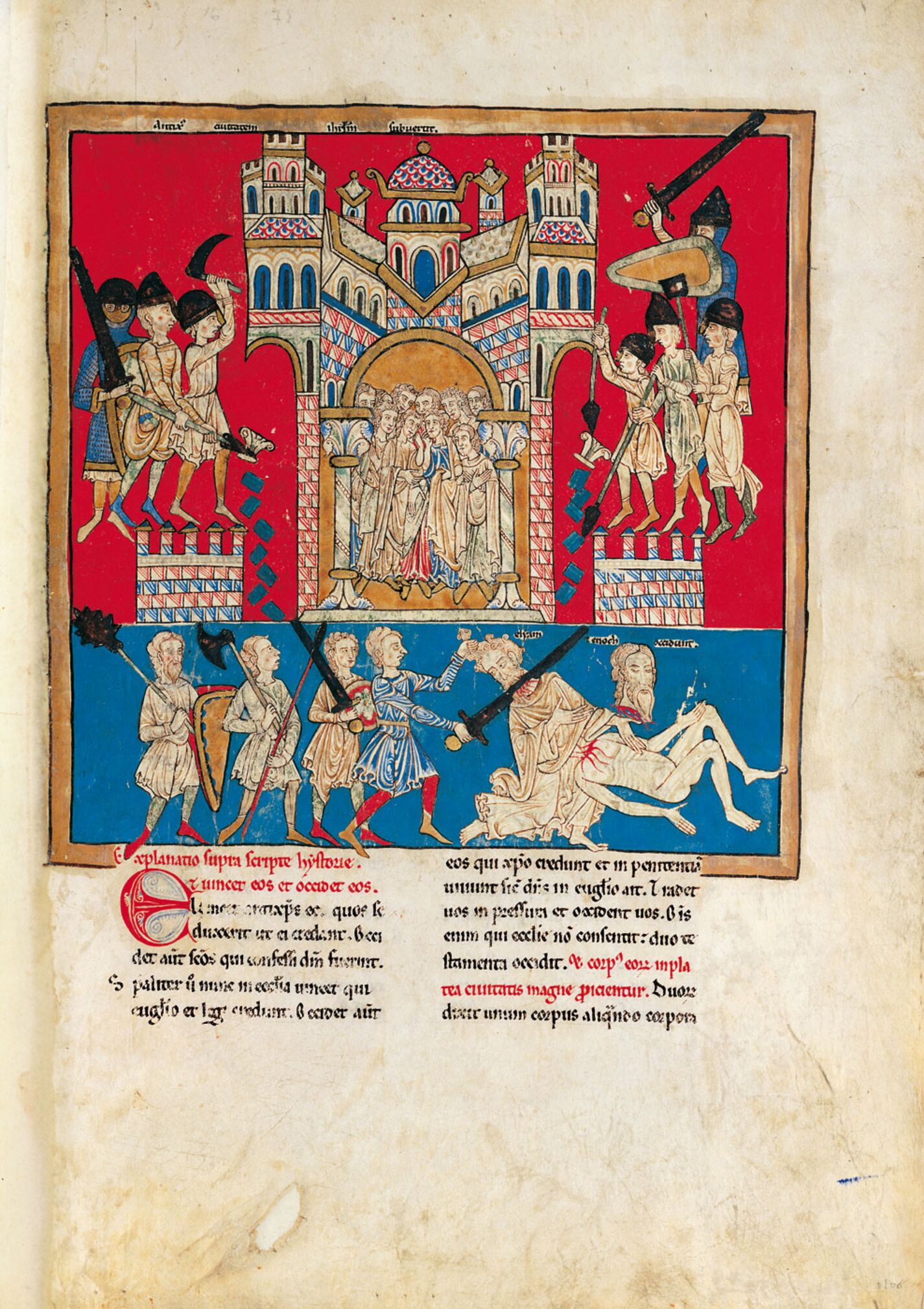
As Williams points out, although according to the storia, the witnesses are killed by the beast from the abyss, the explanatio attributes the crime to the Antichrist. Although the Antichrist is larger than the humans in the Osma, Escalada, Valcavado and Fernando I Beatus, it is somewhat smaller in the Gerona codex, and the same size as the other figures in the Cardeña and Manchester (f. 138v) Beatus. Magius once again provides the iconographic source for branch II, which must have incorporated conventions appearing in an earlier archetype into the illustration of the city. The illustration is split into two sections, the upper one depicting the destruction of Sodom and Egypt by the Antichrist, being by far the larger of the two. This identification contradicts the following comment where their Lord was crucified also, i.e. Jerusalem. Indeed, this identification is emphasised in the inscription Ubi antichristus civitatem iherusalem subvertit, a variant found in all the codices except the Osma Beatus [subvertens]. The group of the Antichrist’s soldiers attacking the city was undoubtedly taken from Luke (21: 24): And Jerusalem shall be trodden down by the Gentiles until the times of the nations are fulfilled. Under the entrance arch throngs a crowd of faithful, the victims. A soldier in the bottom band, at the front of a group, slays Elijah after killing Enoch, depicted naked in accordance with the conventions of that time, not complied with in the Arroyo Beatus, in which both figures are depicted clothed (f. 106v).
The illustration in the San Pedro de Cardeña Beatus abides by iconographic convention although pride of place is given to the architecture, using inverted perspectives to highlight its volumetrics. The traditional horseshoe arch is replaced by a round arch in keeping with the Romanesque style. The warriors’ weapons – swords and spears – are utterly realistic as are the soldiers’ helmets. The Rylands codex reproduces this splendid illustration covering most of the folio, but in a mediocre copy that is both smaller and poorer in quality and with certain different elements such as bucklers instead of elongated shields.
Ángela Franco Mata
Chief of the Medieval Antiquities Department, Museo Arqueológico Nacional
(Fragment of the Cardeña Beatus commentary volume)
As Williams points out, although according to the storia, the witnesses are killed by the beast from the abyss, the explanatio attributes the crime to the Antichrist. Although the Antichrist is larger than the humans in the Osma, Escalada, Valcavado and Fernando I Beatus, it is somewhat smaller in the Gerona codex, and the same size as the other figures in the Cardeña and Manchester (f. 138v) Beatus. Magius once again provides the iconographic source for branch II, which must have incorporated conventions appearing in an earlier archetype into the illustration of the city. The illustration is split into two sections, the upper one depicting the destruction of Sodom and Egypt by the Antichrist, being by far the larger of the two. This identification contradicts the following comment where their Lord was crucified also, i.e. Jerusalem. Indeed, this identification is emphasised in the inscription Ubi antichristus civitatem iherusalem subvertit, a variant found in all the codices except the Osma Beatus [subvertens]. The group of the Antichrist’s soldiers attacking the city was undoubtedly taken from Luke (21: 24): And Jerusalem shall be trodden down by the Gentiles until the times of the nations are fulfilled. Under the entrance arch throngs a crowd of faithful, the victims. A soldier in the bottom band, at the front of a group, slays Elijah after killing Enoch, depicted naked in accordance with the conventions of that time, not complied with in the Arroyo Beatus, in which both figures are depicted clothed (f. 106v).
The illustration in the San Pedro de Cardeña Beatus abides by iconographic convention although pride of place is given to the architecture, using inverted perspectives to highlight its volumetrics. The traditional horseshoe arch is replaced by a round arch in keeping with the Romanesque style. The warriors’ weapons – swords and spears – are utterly realistic as are the soldiers’ helmets. The Rylands codex reproduces this splendid illustration covering most of the folio, but in a mediocre copy that is both smaller and poorer in quality and with certain different elements such as bucklers instead of elongated shields.
Ángela Franco Mata
Chief of the Medieval Antiquities Department, Museo Arqueológico Nacional
(Fragment of the Cardeña Beatus commentary volume)
