The illumination by the Catalan master stretches uninterruptedly from f. 93r to the end of the manuscript. Folio 93r is, in fact, the last of the folios where Ferrer Bassa’s work is still based on an English drawing. The miniature is divided into two registers but only the upper one is a combined, Anglo-Catalan effort. The psalm refers to David begging God for help to face his enemies. He then makes sacrifices and praises the Lord in exchange for his help.
The image is a view of a splendid, open temple and the altar inset in its triangular façade flanked by attractive, round towers. The base of each tower features imitation inverted capitals in line with the design of the English masters. Two large figures located near a second altar are in keeping with the late twelfth-century layout. An old priest with a long beard seems to be pointing out the sacrificial fire, being approached by a small ass, to a man armed with a shield and carrying a phylactery, possibly in reference to the prayer to the Lord. The image would therefore match the sacrifice and praise mentioned in the eighth verse: Voluntarie sacrificabo tibi, et confitebor nomini tuo Domine: quoniam bonum est // I will freely sacrifice to thee, and will give praise, O God, to thy name: because it is good. Furthermore, this second figure, somewhat younger than the priest, seems to receive a heavenly blessing. This might be the David portrayed with rather different importance in earlier psalters, providing a link to the themes depicted in the bottom register. The psalm refers to the figure of Achimelech, the priest who helped David and was then killed by Doeg Idumeus on king Saul’s orders (v. 2, see I Sam. 22: 9).
On the left of a dividing column is a scowling, young man riding backwards on a horse he cannot guide well despite the whips he brandishes in one hand to control the animal. Consequently, despite his determination, he does not know where he is going. The image may refer to both the blindness of some people and certain forms of madness or injustice. In his commentary on this psalm, St Augustine mentions the stupid or imprudent man unable to attain David’s wisdom.
Ferrer Bassa’s work in the lower register is no longer based on a prior English design and depicts the first of a series of clearly narrative scenes. They depict the tale of David and Saul, chosen not so much because of the prayers in the psalm but because of its first verses: Cum venissent Ziphaei, et dixissent ad Saül: Nonne David absconditus est apud nos? // When the men of Ziph had come and said to Saul: Is not David hidden with us? (v. 2). King Saul’s advisors tell him in the palace of Gabba that David is on mount Hachila (“Ecce David absconditus est in colle Hachila”, I Sam. 26: 1). There we see him with his comrades-in-arms and the most sophisticated weapons. He stands out in the centre between the two groups of soldiers with shields and spears. A tree has grown in the foreground, an identical copy of which appears again in reference to this mountainous place in the following picture with a different perspective that focuses on the right area of the image. From now onwards, this type of vegetation is one of the book’s characteristic landscape elements, although here it serves to establish a very clear narrative link also provided by the regular and meticulous portrayal of garments.
A complex tale leads to the following episode in which David and one of his companions, identifiable as Abisai, enter Saul’s royal tent whilst his colleagues wait outside the camp. Still wearing his crown, Saul, who had gone off in search of David, sleeps on a low bed without realising that his opponent has taken his spear and a glass from the head of his bed. The soldiers led by Abner, asleep in front of the blue tent, see nothing either (I Sam. 26: 12). Their presence is, therefore, comparable with that of the Roman soldiers in front of Christ’s tomb. The outcome implies an awareness of past danger. David and Saul will be reconciled but neither the miniature nor the psalm dwell upon this aspect. The main aim is to highlight the victory of David, depicted leaving the camp to show that he overcame his adversary without having to take up arms.
The initials were left blank as shown by the fact that the Catalan workshop works on them freely with no English guidelines. Inside the first D, crowned by an acanthus motif, is a small, half-length figure praying. The middle initial is decorated with foliate motifs alone but the third and largest initial features a full-length figure gazing upwards against a red chequered ground. The profile of his body, positioned sideways without turning its back on the beholder completely, suggests a link to the events in the pictures overhead.
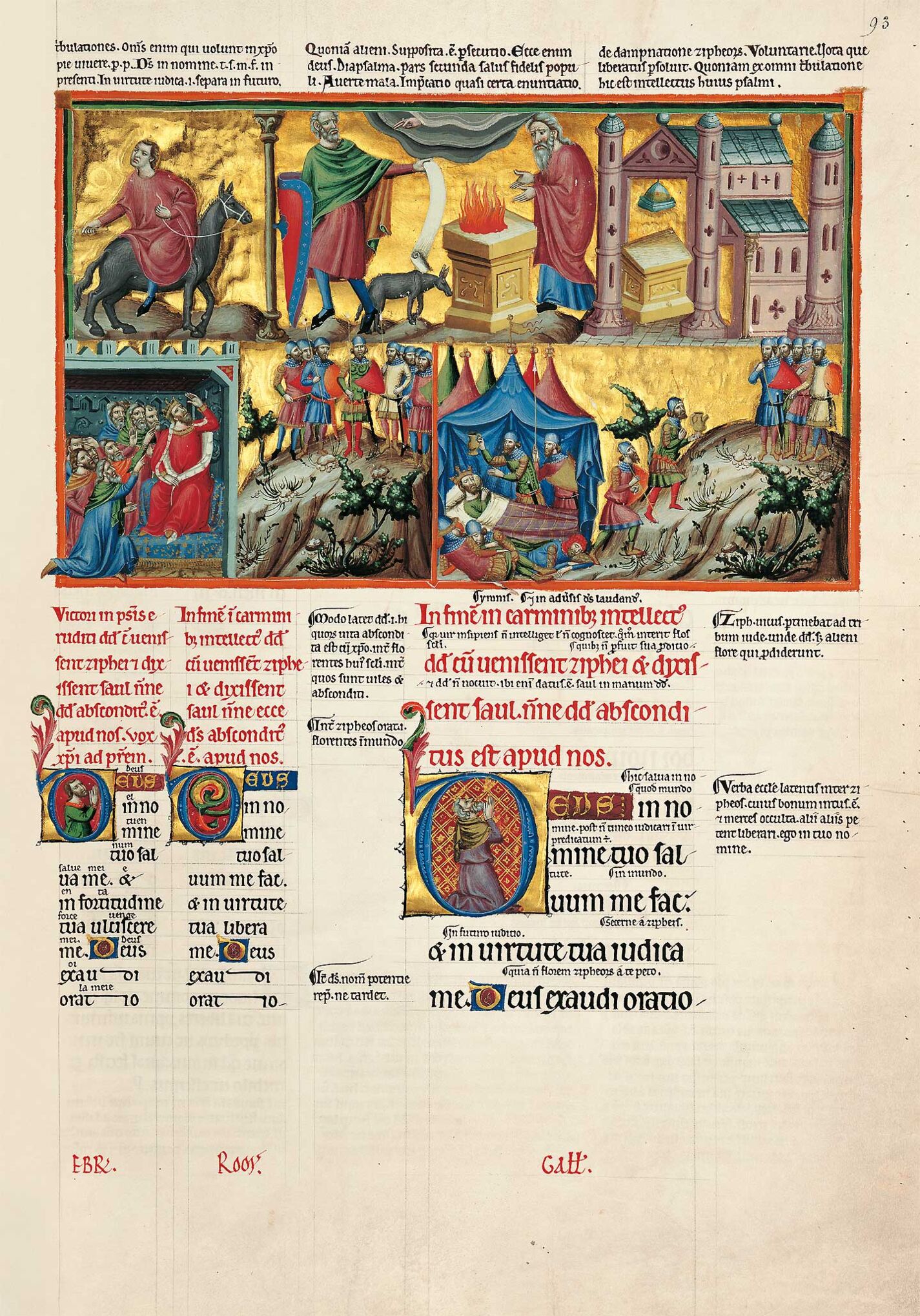
The illumination by the Catalan master stretches uninterruptedly from f. 93r to the end of the manuscript. Folio 93r is, in fact, the last of the folios where Ferrer Bassa’s work is still based on an English drawing. The miniature is divided into two registers but only the upper one is a combined, Anglo-Catalan effort. The psalm refers to David begging God for help to face his enemies. He then makes sacrifices and praises the Lord in exchange for his help.
The image is a view of a splendid, open temple and the altar inset in its triangular façade flanked by attractive, round towers. The base of each tower features imitation inverted capitals in line with the design of the English masters. Two large figures located near a second altar are in keeping with the late twelfth-century layout. An old priest with a long beard seems to be pointing out the sacrificial fire, being approached by a small ass, to a man armed with a shield and carrying a phylactery, possibly in reference to the prayer to the Lord. The image would therefore match the sacrifice and praise mentioned in the eighth verse: Voluntarie sacrificabo tibi, et confitebor nomini tuo Domine: quoniam bonum est // I will freely sacrifice to thee, and will give praise, O God, to thy name: because it is good. Furthermore, this second figure, somewhat younger than the priest, seems to receive a heavenly blessing. This might be the David portrayed with rather different importance in earlier psalters, providing a link to the themes depicted in the bottom register. The psalm refers to the figure of Achimelech, the priest who helped David and was then killed by Doeg Idumeus on king Saul’s orders (v. 2, see I Sam. 22: 9).
On the left of a dividing column is a scowling, young man riding backwards on a horse he cannot guide well despite the whips he brandishes in one hand to control the animal. Consequently, despite his determination, he does not know where he is going. The image may refer to both the blindness of some people and certain forms of madness or injustice. In his commentary on this psalm, St Augustine mentions the stupid or imprudent man unable to attain David’s wisdom.
Ferrer Bassa’s work in the lower register is no longer based on a prior English design and depicts the first of a series of clearly narrative scenes. They depict the tale of David and Saul, chosen not so much because of the prayers in the psalm but because of its first verses: Cum venissent Ziphaei, et dixissent ad Saül: Nonne David absconditus est apud nos? // When the men of Ziph had come and said to Saul: Is not David hidden with us? (v. 2). King Saul’s advisors tell him in the palace of Gabba that David is on mount Hachila (“Ecce David absconditus est in colle Hachila”, I Sam. 26: 1). There we see him with his comrades-in-arms and the most sophisticated weapons. He stands out in the centre between the two groups of soldiers with shields and spears. A tree has grown in the foreground, an identical copy of which appears again in reference to this mountainous place in the following picture with a different perspective that focuses on the right area of the image. From now onwards, this type of vegetation is one of the book’s characteristic landscape elements, although here it serves to establish a very clear narrative link also provided by the regular and meticulous portrayal of garments.
A complex tale leads to the following episode in which David and one of his companions, identifiable as Abisai, enter Saul’s royal tent whilst his colleagues wait outside the camp. Still wearing his crown, Saul, who had gone off in search of David, sleeps on a low bed without realising that his opponent has taken his spear and a glass from the head of his bed. The soldiers led by Abner, asleep in front of the blue tent, see nothing either (I Sam. 26: 12). Their presence is, therefore, comparable with that of the Roman soldiers in front of Christ’s tomb. The outcome implies an awareness of past danger. David and Saul will be reconciled but neither the miniature nor the psalm dwell upon this aspect. The main aim is to highlight the victory of David, depicted leaving the camp to show that he overcame his adversary without having to take up arms.
The initials were left blank as shown by the fact that the Catalan workshop works on them freely with no English guidelines. Inside the first D, crowned by an acanthus motif, is a small, half-length figure praying. The middle initial is decorated with foliate motifs alone but the third and largest initial features a full-length figure gazing upwards against a red chequered ground. The profile of his body, positioned sideways without turning its back on the beholder completely, suggests a link to the events in the pictures overhead.
