The psalm opens with an exhortation to the judges, the sons of men, begging a fair judgement (v. 2, Si vere utique justitiam loquimini: recta judicate, filii hominum // If in very deed ye speak justice: judge right things, ye sons of men). The miniature shows first the magistrate, now enthroned and facing forwards, with the text of the law in his hand. He is surrounded by the people who are to make statements about the matters he is to consider whilst a smaller scribe, sitting on the ground, takes the minutes of the meeting. The figure of the scribe was commonplace in Catalan miniatures in the first half of the 14th century, above all in books of Usatges and Constitutions of Catalonia, particularly, in the Italianate phase, the Llibre Verd of Barcelona and the codex housed in the Paeria in Lérida (ms. 1327). The psalm, again portrayed in two registers, refers to the injustices wrought by mankind. The scene alongside that of the judge depicts the robbery and murder of three individuals: a naked man and another in underwear are already dead, whilst the third is being struck with a sword by two thugs who seem to have been hired by a third criminal who negotiates with them in a manner reminiscent of the unsightly gambling of the soldiers at the foot of mount Calvary. As St Augustine points out, after the first fall, sin multiplies (“Connexum est peccatum peccato”). The third space is smaller and features just one figure: a judge walking along the narrow path of life. He carries an open book and must deal with the deaf snake or asp covering its ears (the coiled reptile depicted hiding in the bush growing by the narrow path) (v. 5, Furor illis secundum similitudinem serpentis: sicut aspidis surdae et obturantis aures suas // Their madness is according to the likeness of a serpent: like the deaf asp that stoppeth her ears) which, according to the psalter, thus associates itself with sinners and evil men whose pride will be perturbed, like the lions in the following picture. The lions are portrayed here as rampant figures whom God attacks by means of archer angels implementing his will or divine anger, as already seen elsewhere (v. 7). Between the two groups of felines runs a river that conveys the content of one of the verses from the text (v. 8, Ad nihilum devenient tamquam aqua decurrrens: intendit arcum suum donec intirmentur // They shall come to nothing, like water running down; he hath bent his bow till they be weakened).
The well-known premise that the chosen ones revel in the punishment of the wicked is condemned in the psalm (v. 11, Laetabitur justus cum videret vindictam: manus suas lababit in sanguine peccatoris // The just shall rejoice when he shall see the revenge: he shall wash his hands in the blood of the sinner) and reflected here in the monk washing his hands in a fountain flowing with red liquid (the sinner’s blood) just before praying to God and praising him. God replies surrounded by praying angels upon the arch of Heaven. The most eye-catching element is undeniably the fourteenth-century fountain with its polygonal base and greyish-white imitation marble colour that contrasts with the red liquid against an open landscape. It is reminiscent of some of the paintings by Pietro Lorenzetti on the gradin of the Pala del Carmine (c. 1329), with the noteworthy presence of monumental fountains of a similar type. Pride leads to destruction and punishment implies the descent of the damned into Hell. This is the sequence chosen by the painter to conclude the images with Leviathan’s terrible, gaping throat in which naked and dressed human beings pile up. The bodies are pushed in by four black demons who, despite their characteristic monster heads, claws, batwings and tails, are anthropomorphic in appearance.
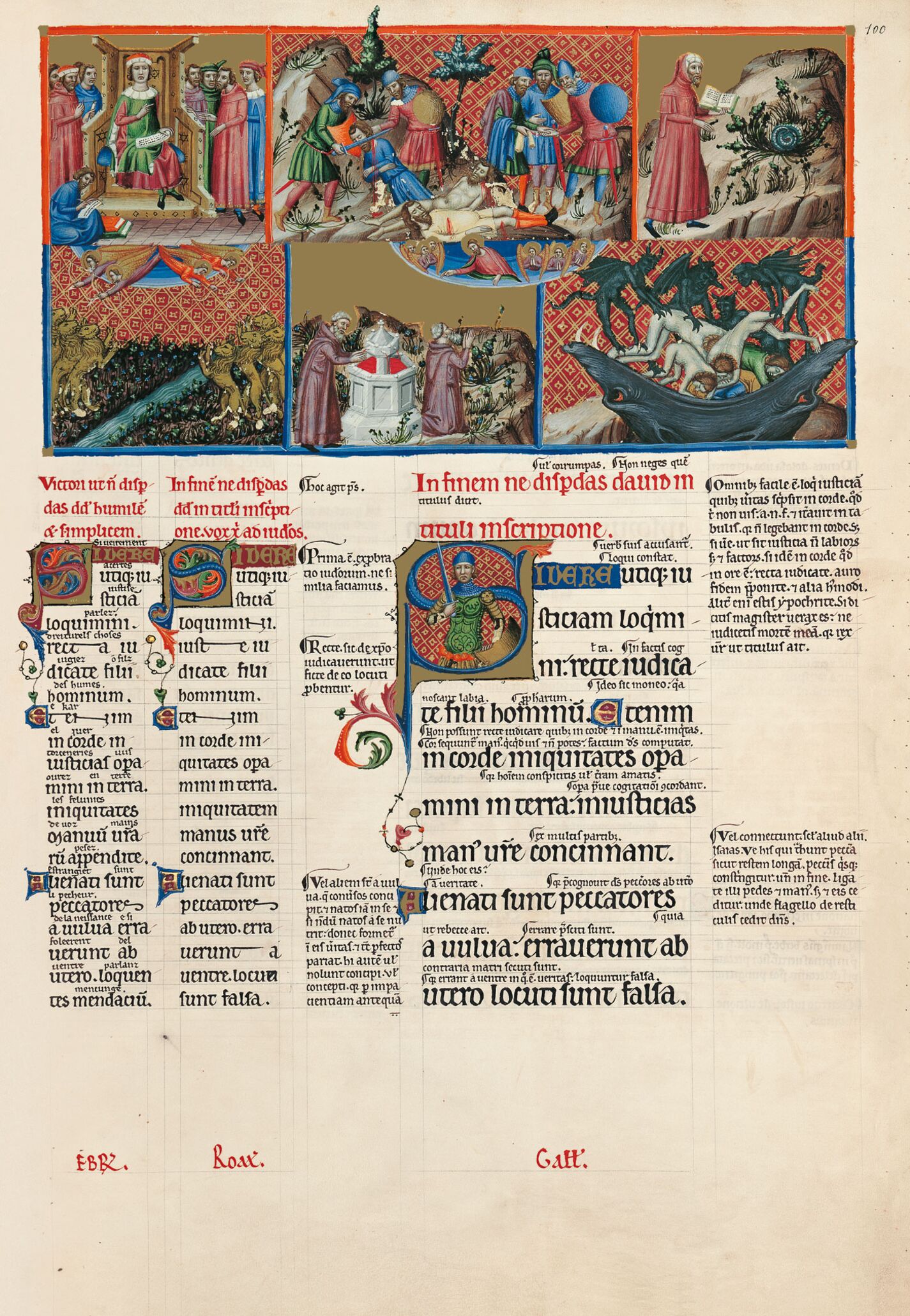
The psalm opens with an exhortation to the judges, the sons of men, begging a fair judgement (v. 2, Si vere utique justitiam loquimini: recta judicate, filii hominum // If in very deed ye speak justice: judge right things, ye sons of men). The miniature shows first the magistrate, now enthroned and facing forwards, with the text of the law in his hand. He is surrounded by the people who are to make statements about the matters he is to consider whilst a smaller scribe, sitting on the ground, takes the minutes of the meeting. The figure of the scribe was commonplace in Catalan miniatures in the first half of the 14th century, above all in books of Usatges and Constitutions of Catalonia, particularly, in the Italianate phase, the Llibre Verd of Barcelona and the codex housed in the Paeria in Lérida (ms. 1327). The psalm, again portrayed in two registers, refers to the injustices wrought by mankind. The scene alongside that of the judge depicts the robbery and murder of three individuals: a naked man and another in underwear are already dead, whilst the third is being struck with a sword by two thugs who seem to have been hired by a third criminal who negotiates with them in a manner reminiscent of the unsightly gambling of the soldiers at the foot of mount Calvary. As St Augustine points out, after the first fall, sin multiplies (“Connexum est peccatum peccato”). The third space is smaller and features just one figure: a judge walking along the narrow path of life. He carries an open book and must deal with the deaf snake or asp covering its ears (the coiled reptile depicted hiding in the bush growing by the narrow path) (v. 5, Furor illis secundum similitudinem serpentis: sicut aspidis surdae et obturantis aures suas // Their madness is according to the likeness of a serpent: like the deaf asp that stoppeth her ears) which, according to the psalter, thus associates itself with sinners and evil men whose pride will be perturbed, like the lions in the following picture. The lions are portrayed here as rampant figures whom God attacks by means of archer angels implementing his will or divine anger, as already seen elsewhere (v. 7). Between the two groups of felines runs a river that conveys the content of one of the verses from the text (v. 8, Ad nihilum devenient tamquam aqua decurrrens: intendit arcum suum donec intirmentur // They shall come to nothing, like water running down; he hath bent his bow till they be weakened).
The well-known premise that the chosen ones revel in the punishment of the wicked is condemned in the psalm (v. 11, Laetabitur justus cum videret vindictam: manus suas lababit in sanguine peccatoris // The just shall rejoice when he shall see the revenge: he shall wash his hands in the blood of the sinner) and reflected here in the monk washing his hands in a fountain flowing with red liquid (the sinner’s blood) just before praying to God and praising him. God replies surrounded by praying angels upon the arch of Heaven. The most eye-catching element is undeniably the fourteenth-century fountain with its polygonal base and greyish-white imitation marble colour that contrasts with the red liquid against an open landscape. It is reminiscent of some of the paintings by Pietro Lorenzetti on the gradin of the Pala del Carmine (c. 1329), with the noteworthy presence of monumental fountains of a similar type. Pride leads to destruction and punishment implies the descent of the damned into Hell. This is the sequence chosen by the painter to conclude the images with Leviathan’s terrible, gaping throat in which naked and dressed human beings pile up. The bodies are pushed in by four black demons who, despite their characteristic monster heads, claws, batwings and tails, are anthropomorphic in appearance.
