When François I received an illuminated Roman de la Rose, he was given more than a beautiful book—he was given a vision of how to interpret it. This manuscript opens a window onto the poem’s two authors, two voices, and two competing understandings of love.
Among the extant manuscripts of the Roman de la Rose, none equals the exquisite beauty of the version presented to François I, King of France, shortly after 1521. From the first glimpse of its magnificent illuminations and fine calligraphy, the work transfixes the reader. That fascination begins on the first illuminated folio: a sumptuous painting of a royal coat of arms and the stunning visual impression made by the juxtaposition of the blazon with the folio showing the portrait of François I receiving this unique manuscript from the hands of the kneeling scribe, Girard Acarie, who planned and executed it. The Roman de la Rose was one of this humanist king’s favourite books. He relished its vast array of classical philosophy, myth, literature, and science that assured its place as the first, but also the most controversial French classic.
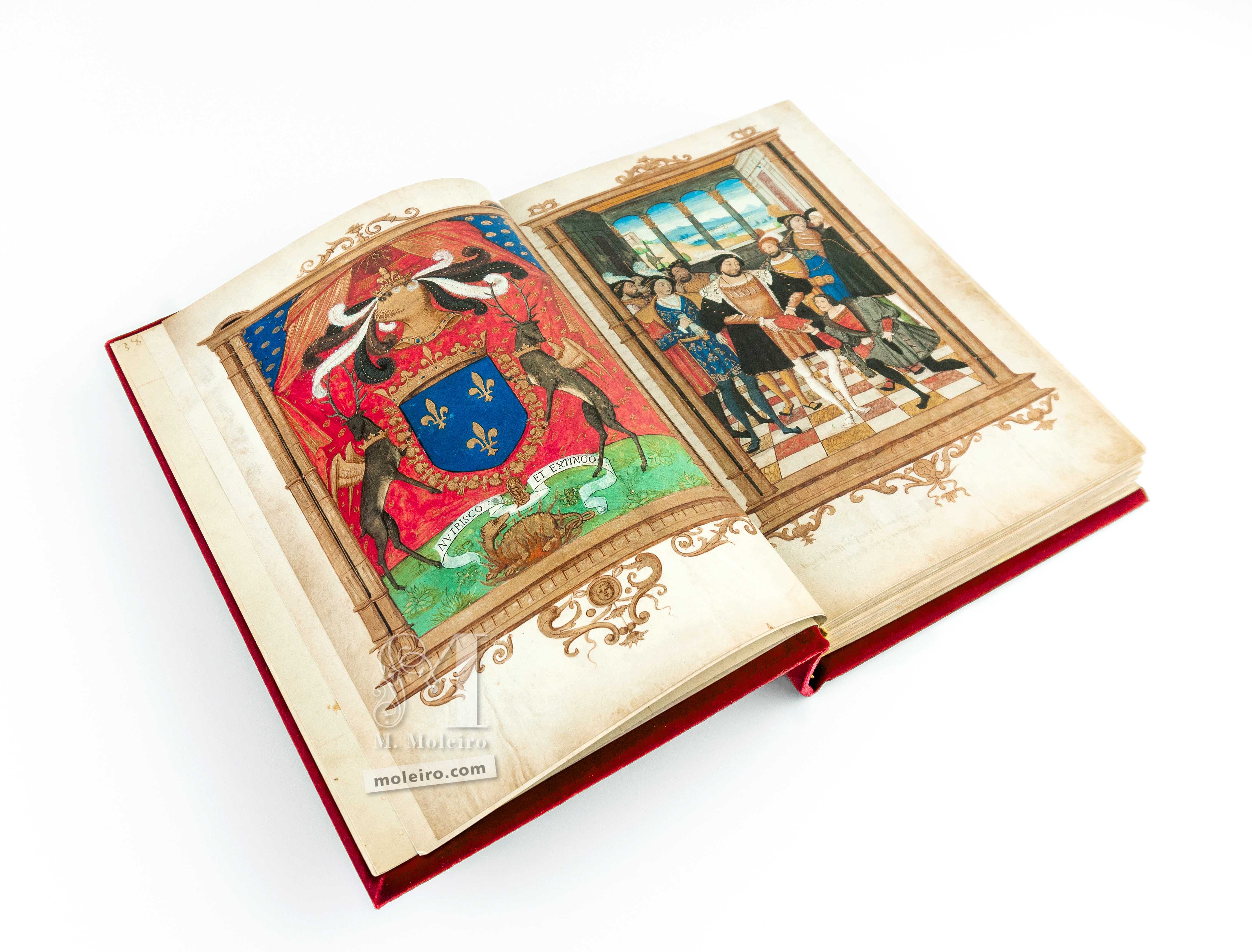
Coat of arms of François I alongside his portrait receiving the manuscript of Roman de la Rose
The Roman de la Rose of François I
ff. 3v–4r © M. Moleiro Editor
First of all, it was what is known today as a breakthrough book, unlike anything that had come before. This was due not so much to the fact that it had two authors, Guillaume de Lorris and Jean de Meun, but to the fact that the two parts of the book, written c. 1235 and c. 1280, were disparate in length—4,000 versus 18,000 lines approximately—but even more varied in style, approach, and content. Guillaume de Lorris is a poet in tune with the idealised love lyric of the twelfth and early thirteenth century. A gifted lyricist who evokes lively scenes of nature, ekphrastic images rivaling in vividness the paintings they depict, and lifelike personifications, Guillaume charts new pathways for the genre of romance .
Jean de Meun, writing some fifty years later, c. 1280, was part of a philosophical revolution, for which Thomas Aquinas was a leader. Grounded in Aristotelian materialism rather than Platonic idealism, these philosophers used the materiality of language to study philosophical questions. Jean himself takes pains to point out the absurdity of using euphemistic rather than natural terms to refer, for example, to body parts. His poem satirises Guillaume’s, whose approximately 4,000 lines employ only euphemisms for the sexual passion it takes as its theme.
As a poet, Jean prefers dialectical exchanges to lyrical description. He makes constant use of classical myths which serve as parables, as illustrations, or to emphasise his philosophical agenda. In accord with his preference for ordinary language, Jean redeploys Guillaume’s personifications so that their actions perform their names, e.g. Jealous Husband (Le Jaloux) verbally berates and physically beats his wife (as the coloured miniatures delight in depicting). This is Jean’s way of marking the contrast between euphemism and ordinary language.