In a remote region of the medieval world stood a dazzling city: Baudac, better known as Baghdad, near the one that in Holy Scripture is called Susa, in ancient Iran. Many people of diverse races live there: numerous Jews and pagans, but above all Saracens. There resides the chief prelate of all the Saracens in the world, whom they call the Caliph, just as in Rome resides the head of all Christians. Some Christians also live in the city, although most of them are heretics, and only a few remain faithful to the true faith.
It is said that the city is so vast tha of merchants constantly sail, laden with goods. From Baghdad to that sea, there are about eighteen days of navigation, though the duration varies according to currents and winds. Merchants wishing to go to India follow the course of the river to the city of Kish, where they reach the sea; and between Baghdad and Kish, on the banks of the same river (the Tigris), stands another great city called Basra.
It should also be known that the Caliph of Baghdad possessed the greatest treasure in gold, silver, and precious stones ever gathered by any man. And it was precisely because of such wealth that he met a death as lamentable as it was exemplary.
Around the year 1255 after the birth of Christ, the great lord of the eastern Tatars, called Hulagu, brother of the powerful Kublai Khan, gathered a vast army of cavalry and infantry and marched against the Caliph, besieging the city of Baghdad until he conquered it. This was a notable enterprise, for the city contained more than one hundred thousand horsemen, not counting the infantry. Once inside, Hulagu discovered a tower filled with gold, silver, and treasures belonging to the Caliph, so abundant that nothing like it had ever been seen. However, the Caliph's greed -having failed to maintain a sufficient army or reward his knights- was the cause of his downfall.
Astonished at such wealth, Hulagu summoned the Caliph and said:
- Why have you amassed so many riches? I am amazed at your greed and your miserliness in not sharing them with your knights and your people. Did you not know that I was your enemy and that I was advancing against you with a great army to strip you of your dominions? When you learned this, why did you not use your treasure to secure your defense?
The Caliph, confused and terrified, did not know how to respond. Then Hulagu added:
- Since you love your treasure so much, I shall make you feed on it.
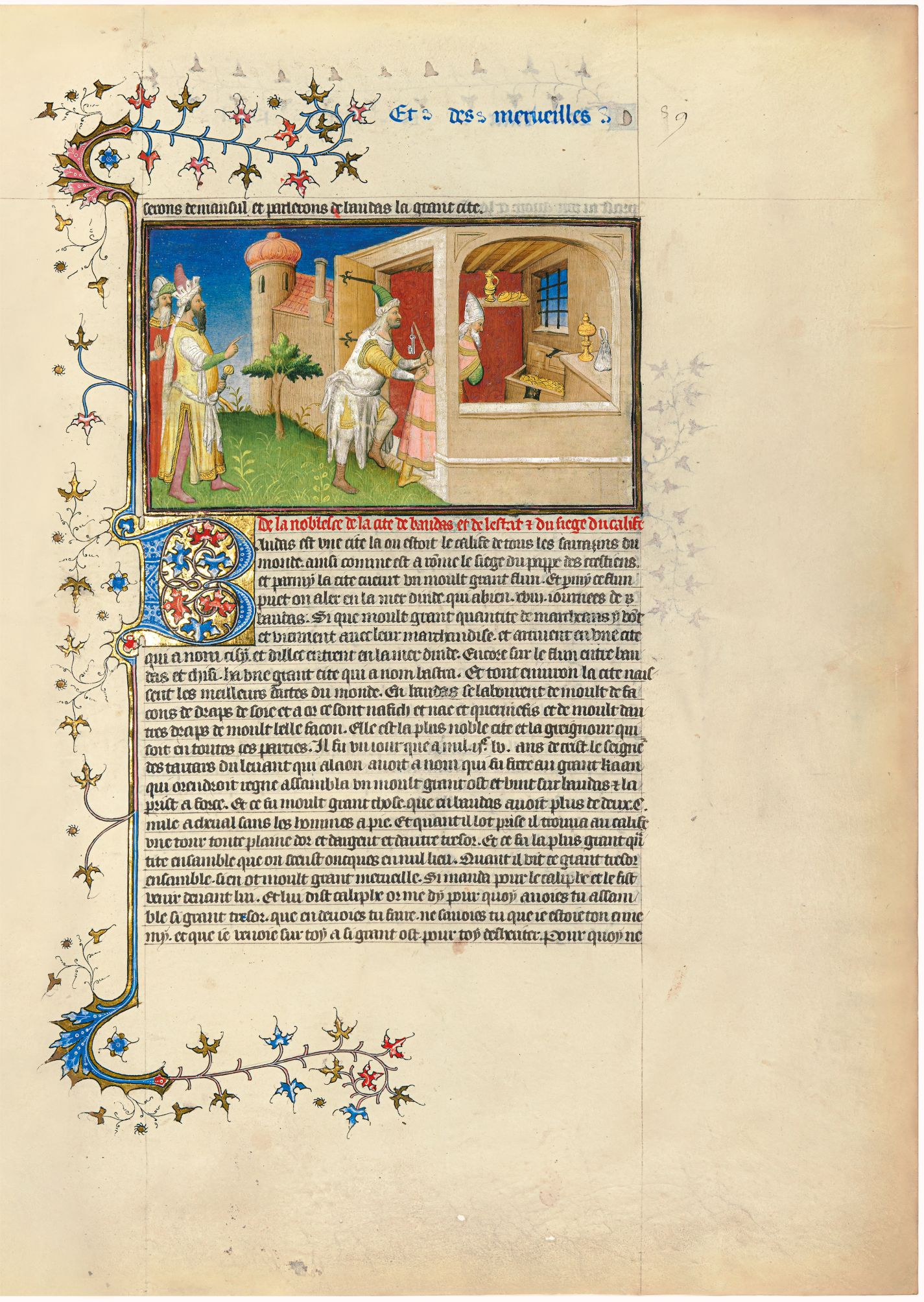
And he ordered him to be locked in the tower where the riches were kept, forbidding that he be given any food or drink. Before leaving him, he said:
- Feed now on what you have loved so much, for you shall taste nothing else.
There the Caliph was left, and realizing too late his error, unable to obtain sustenance from his riches, he died of hunger after four days, like the humblest of servants. It would have been better for him to distribute his treasure among his men to secure their loyalty and defense, rather than lose everything -life, kingdom, and subjects- through his greed.
In a remote region of the medieval world stood a dazzling city: Baudac, better known as Baghdad, near the one that in Holy Scripture is called Susa, in ancient Iran. Many people of diverse races live there: numerous Jews and pagans, but above all Saracens. There resides the chief prelate of all the Saracens in the world, whom they call the Caliph, just as in Rome resides the head of all Christians. Some Christians also live in the city, although most of them are heretics, and only a few remain faithful to the true faith.
It is said that the city is so vast tha of merchants constantly sail, laden with goods. From Baghdad to that sea, there are about eighteen days of navigation, though the duration varies according to currents and winds. Merchants wishing to go to India follow the course of the river to the city of Kish, where they reach the sea; and between Baghdad and Kish, on the banks of the same river (the Tigris), stands another great city called Basra.
It should also be known that the Caliph of Baghdad possessed the greatest treasure in gold, silver, and precious stones ever gathered by any man. And it was precisely because of such wealth that he met a death as lamentable as it was exemplary.
Around the year 1255 after the birth of Christ, the great lord of the eastern Tatars, called Hulagu, brother of the powerful Kublai Khan, gathered a vast army of cavalry and infantry and marched against the Caliph, besieging the city of Baghdad until he conquered it. This was a notable enterprise, for the city contained more than one hundred thousand horsemen, not counting the infantry. Once inside, Hulagu discovered a tower filled with gold, silver, and treasures belonging to the Caliph, so abundant that nothing like it had ever been seen. However, the Caliph's greed -having failed to maintain a sufficient army or reward his knights- was the cause of his downfall.
Astonished at such wealth, Hulagu summoned the Caliph and said:
- Why have you amassed so many riches? I am amazed at your greed and your miserliness in not sharing them with your knights and your people. Did you not know that I was your enemy and that I was advancing against you with a great army to strip you of your dominions? When you learned this, why did you not use your treasure to secure your defense?
The Caliph, confused and terrified, did not know how to respond. Then Hulagu added:
- Since you love your treasure so much, I shall make you feed on it.
And he ordered him to be locked in the tower where the riches were kept, forbidding that he be given any food or drink. Before leaving him, he said:
- Feed now on what you have loved so much, for you shall taste nothing else.
There the Caliph was left, and realizing too late his error, unable to obtain sustenance from his riches, he died of hunger after four days, like the humblest of servants. It would have been better for him to distribute his treasure among his men to secure their loyalty and defense, rather than lose everything -life, kingdom, and subjects- through his greed.
