On the coast lies the port city of Courmos (Hormuz), where ships arrive laden with all kinds of spices, precious stones and pearls, silk and gold fabrics, elephants' tusks, and many other goods. In this city they sell these goods to other merchants, who then distribute them throughout the world, selling them to others in turn. It is a city bustling with commercial activity. [. . .]
Their ships are of poor quality and many of them shipwreck because they are not fastened with iron nails, but are sewn together with thread made from the bark of coconut trees. They beat the bark until it becomes like horsehair, from which they make thread to sew their ships. This thread holds up well and does not rot in seawater, but it does not hold out against a storm. The ships have one mast, one sail, and a rudder, and they are open-decked except when loaded; the cargo is then covered with hides, and upon these hides they place the horses they are transporting for sale. They have no iron to make nails, which is why they make wooden pegs to fasten their ships, and then sew them with the thread I mentioned above. Therefore, sailing in these ships is dangerous, and many of them sink, for there are often very violent storms in the Indian Ocean.
The people of this country are black and worship Muhammad. [In summer] they do not stay in the cities, where the heat is so fierce that they would all die; instead they head out to their gardens, where there are streams and water in abundance. However, they still would not survive if not for what I am about to tell you. It is a fact that in summer, a wind so excessively hot often comes upon them from the surrounding desert plain that it would kill them all, were it not that as soon as they feel this hot wind approaching, they plunge into the water up to their necks and stay there until it subsides. They sow their wheat, barley, and other grains in the month of November and harvest them in March. They have no greenery except for dates, which last until May; all of this is due to the intense heat that dries everything up. Their ships do not rot as easily because they coat them with fish oil. When someone dies, they display immense grief, for they mourn them for four whole years. At least once a day, relatives, friends, and neighbors lament and gather together to express their mourning with loud cries and weeping.
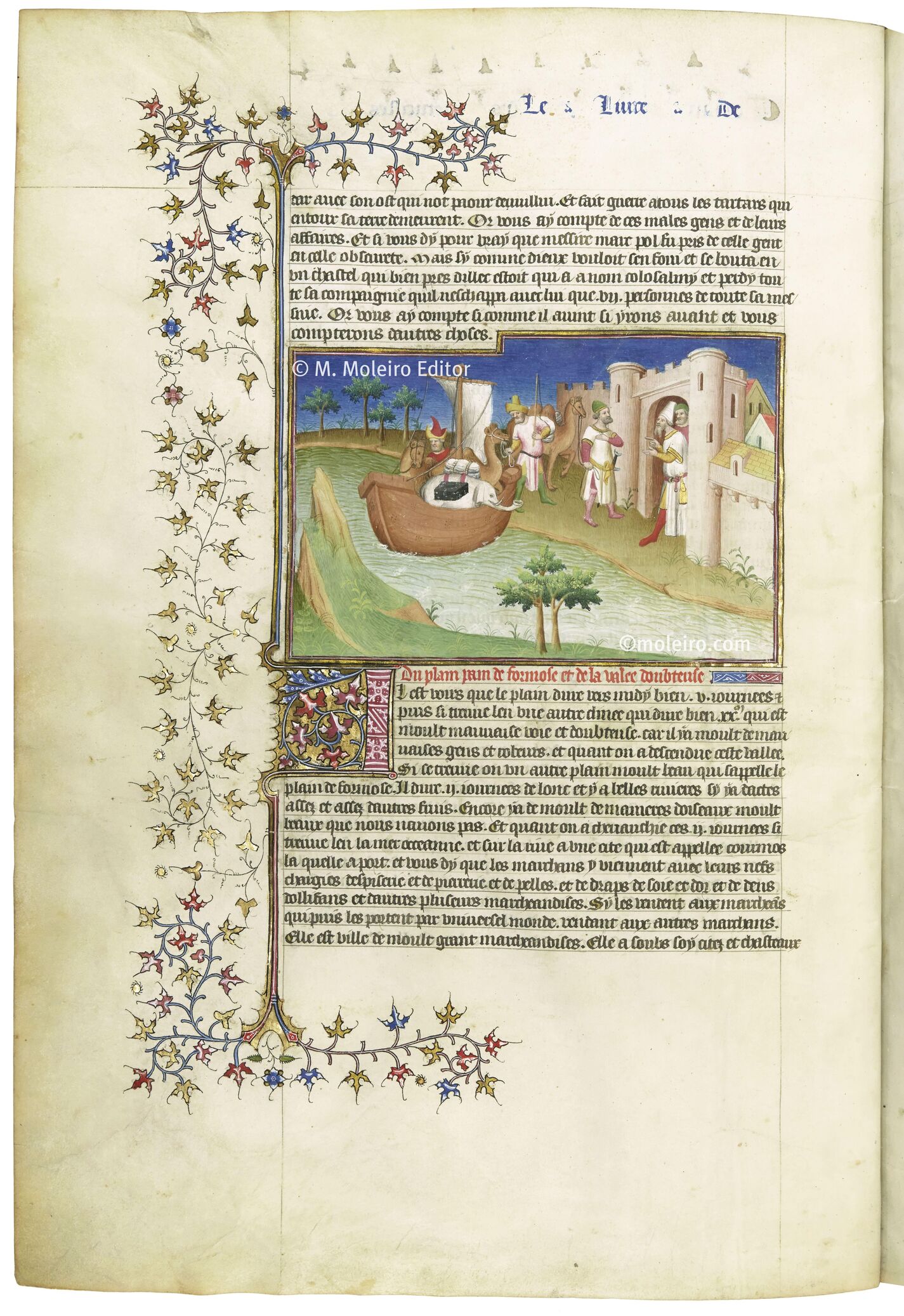
On the coast lies the port city of Courmos (Hormuz), where ships arrive laden with all kinds of spices, precious stones and pearls, silk and gold fabrics, elephants' tusks, and many other goods. In this city they sell these goods to other merchants, who then distribute them throughout the world, selling them to others in turn. It is a city bustling with commercial activity. [. . .]
Their ships are of poor quality and many of them shipwreck because they are not fastened with iron nails, but are sewn together with thread made from the bark of coconut trees. They beat the bark until it becomes like horsehair, from which they make thread to sew their ships. This thread holds up well and does not rot in seawater, but it does not hold out against a storm. The ships have one mast, one sail, and a rudder, and they are open-decked except when loaded; the cargo is then covered with hides, and upon these hides they place the horses they are transporting for sale. They have no iron to make nails, which is why they make wooden pegs to fasten their ships, and then sew them with the thread I mentioned above. Therefore, sailing in these ships is dangerous, and many of them sink, for there are often very violent storms in the Indian Ocean.
The people of this country are black and worship Muhammad. [In summer] they do not stay in the cities, where the heat is so fierce that they would all die; instead they head out to their gardens, where there are streams and water in abundance. However, they still would not survive if not for what I am about to tell you. It is a fact that in summer, a wind so excessively hot often comes upon them from the surrounding desert plain that it would kill them all, were it not that as soon as they feel this hot wind approaching, they plunge into the water up to their necks and stay there until it subsides. They sow their wheat, barley, and other grains in the month of November and harvest them in March. They have no greenery except for dates, which last until May; all of this is due to the intense heat that dries everything up. Their ships do not rot as easily because they coat them with fish oil. When someone dies, they display immense grief, for they mourn them for four whole years. At least once a day, relatives, friends, and neighbors lament and gather together to express their mourning with loud cries and weeping.
